
Survey first: $300–$750
A recorded camera run with distances marked. Yours to keep, and usually credited if the work goes ahead.
Relining turns a recurring drainage problem into a finished one. The joints that roots come through are sealed along the whole run, so there is no way back in, and nothing above the pipe gets disturbed to do it.
The failure that brings most people here is not a broken pipe. It is a joint. Older drainage is laid in short lengths, so a single run has a great many joints, and after decades of ground movement and root pressure they open a fraction at a time until something backs up.
A liner seals all of them in one pass, which is why it changes the pattern rather than resetting it. Cutting roots out clears the pipe and leaves the way in exactly as it was, and the interval to the next blockage is set by how fast they grow back.
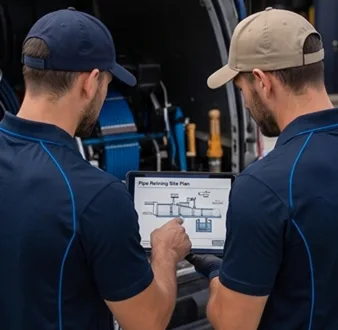
In a strip of tenancies the drainage is frequently shared, which means the fault is often not under the premises reporting it, and the party who pays is not always the party who called.
That is worth settling before the quote rather than after. Camera footage with distances marked from a known access point is what makes the conversation with a landlord or a neighbouring tenant short, because it shows exactly where the defect sits.
Properties on a slope often have long drainage runs, sometimes crossing the whole block to reach the main. The practical questions are where the inspection openings are and whether the liner can be drawn through in one length or needs a second access.
That is worth establishing before quoting. A single long run costs less per metre than the same distance broken into stages, and the difference is decided by access, not by the pipe.
People are often surprised that a drain laid before the war is a relining candidate rather than a replacement. Age alone does not decide it. A clay line with a sound barrel and tired joints is close to the best case for a liner.
The cases that genuinely need excavation are different: a collapsed section, a run that has lost its fall, or a pipe crushed out of round. A camera separates those in an hour, and the answer changes the cost by a multiple.
On Clyde’s low, flat ground near the rail corridor, heavy rain overwhelms stormwater pits and drains that silt up and back up.
Most people associate relining with sewers, but stormwater suffers the same failures and reline just as well: cracked lengths, open joints, roots, and sections that have silted because the fall has flattened. On a property that floods in every serious downpour, the line is often the reason rather than the rain.
The camera run matters more here than anywhere. Clearing a surcharging pit at the height of a storm tells you almost nothing; the same line inspected on a dry day tells you whether you have a blockage or a defect.
Many of Clyde’s older homes and sites still run decades-old clay or cast-iron pipework that cracks, corrodes and lets roots and debris in.
Cutting roots out clears the pipe and does nothing about the way in. The joint they came through is still open, the tree is still looking for water, and the interval before the next blockage is set by how fast it grows back. That is why a jetted line often reblocks on a schedule you could almost diary.
A liner seals the full run, joints included, so there is no opening left to find. It is the one intervention that changes the pattern instead of resetting the clock.
Removing a mature tree is expensive, often needs approval, and frequently does not solve it: the roots already inside the pipe do not leave when the trunk does, and the joint is still open for the next one.
Established trees along Clyde’s older streets send roots hunting into cracked pipe joints, a common cause of recurring blockages here.
Relining lets both things be true at once. The garden stays as it is and the drain stops being a route to water. For most owners that is the whole appeal, and it is why no-dig gets specified on established blocks far more often than on new ones.
It is not a universal fix and anyone presenting it as one is selling rather than advising. A liner follows the shape of the host pipe, so it cannot correct a run that has lost its fall or sagged into a belly. A collapsed section has nothing to line against. A pipe crushed badly out of round has to be replaced.
In those cases the right answer is excavation, and we would rather quote that and be trusted than reline something that will disappoint you in two years.
A recorded camera run with distances marked. Yours to keep, and usually credited if the work goes ahead.
The prevailing 2026 Sydney range for residential sewer relining.
Proportionate for one fault in a sound run. We will recommend it over a full liner when that is what the camera shows.
For a run failing along its length, which on old clay is the common finding.
Plus reinstatement. On a bare lawn it can win. Under anything you would miss, it usually does not.
Indicative Sydney ranges for 2026. Your job is quoted in writing after the camera survey. Figures here are indicative of the 2026 Sydney market rather than a quote from us, you get your own number as a fixed price before any work starts.

We find the fault, measure it from an access point, and check the fall is intact. That last check is what stops a liner being installed into a belly.
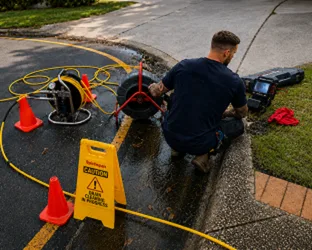
Per metre, with access and junction reinstatement itemised, and the excavation comparison alongside it so you can see both.
Clean, install, cure. One access point, one day for most homes, and no trench across the property.

Branches reopened, final footage, certificate and notification. Keep it with the property file, it is worth real money at sale.
Send it through and we will come back with what it is likely to be, what the survey costs, and whether relining is even the right conversation.
Cost, lifespan, method, and the cases where a liner is the wrong answer.

Call for the fastest answer, or send the form and we will arrange a camera survey before anything is quoted.

Leave your details and our local Clyde team will call you back fast.